Usable funds after restrictions, remaining cash due at closing, unpaid maintenance and program cash, modeled debt payments, and the resources assumed to meet the maturity balance. Keep present liquidity, earmarked reserves and future sale assumptions distinct.
Preview a fictional capital plan
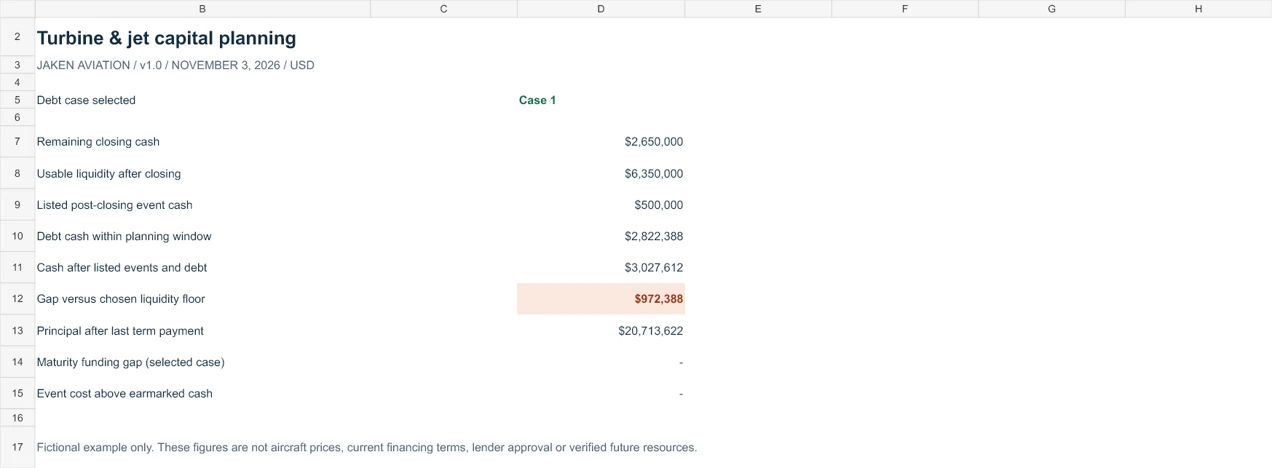
A capital plan for the acquisition you are actually evaluating
The workbook brings four related questions together: what cash is usable now, what the remaining closing payment requires, which listed maintenance or program amounts need funding, and how the selected debt assumptions affect repayment. It supports a financed turboprop or business-jet acquisition with one facility. It is useful for preparing a financing discussion; it does not approve a borrower or decide whether a particular aircraft fits a mission.
Capital shows the linked cash results and the acquisition inputs. Events holds twelve editable rows for unpaid work or program-related amounts, with timing, evidence and responsibility. Debt contains the single facility build and two selectable assumption sets. Questions provides fourteen topics with owners, dates, written answers and review references. The figures start blank, while the guide and preview demonstrate a clearly invented transaction.
The planning date and twelve-month window are editable assumptions. The date is treated as closing for the modeled monthly debt clock. Use the actual lender and closing schedules to reconcile the difference between that simplified clock and real dates. Separate acquisitions, facilities, currencies or complex cross-collateral arrangements require their own coordinated model.
Reconcile available liquidity before counting it as aircraft equity
Begin with liquid resources the relevant party actually holds now, after deposits and earlier escrow transfers have left its accounts. Then identify restricted or pledged funds and other unavailable amounts as distinct portions of that total. A balance belonging to another entity is not available merely because it appears in a consolidated statement. Confirm ownership, permissions, commitments and timing with the responsible advisers.
The workbook rejects restricted and otherwise unavailable portions that exceed the entered total. It also distinguishes usable cash earmarked for events from a new source of money. That earmark must already be included in usable liquidity. It is an allocation inside the pool, rather than an amount added on top of the pool.
A chosen minimum liquidity floor belongs to your planning assumptions. The resulting gap tells you how much more cash this model would need to meet that number after its listed deductions. It is not a lender covenant test or a statement that the funds satisfy a guarantor's obligations. Contract definitions, testing dates, permitted assets and other exposures require separate review.
Keep closing cash and financed fees on one reconciled bridge
Gross principal and financed fees are entered once on Debt. Net proceeds applied to the purchase equal gross principal less the financed-fee input. Capital adds price, other cash acquisition costs and the net owner amounts from active In closing event rows. It then subtracts net proceeds, the applied deposit, confirmed purchase credits and additional cash already in escrow.
The additional escrow input must exclude the deposit already listed. Liquid resources NOW must already reflect those earlier transfers. Other cash acquisition costs must exclude In closing event rows because they are added automatically. These distinctions keep the same transfer or program-related charge from appearing twice in the cash requirement.
Enter each applicable tax and fee in its proper place and confirm explicit zeroes. Jaken fees are due at closing; nothing is charged upfront. Third-party expenses follow their own terms. A negative remaining-closing-cash result may require credit or refund reconciliation, so downstream liquidity remains unavailable until the inputs are resolved. A negative retained-cash result, by contrast, exposes the funding shortfall rather than hiding it as zero.
Use an event cash schedule alongside the technical review
A planned invoice date and an actual maintenance due date answer different questions. The workbook uses cash due dates supplied by the transaction team and quotes; it does not calculate inspection intervals, remaining life or airworthiness. Section 91.409 contains different inspection provisions for specified aircraft categories and operations. Have the technical team determine what applies to the actual aircraft.
Each active event needs an identifying description, treatment, positive cash date, numeric gross unpaid cost, direct-payment amount, evidence reference and owner. Rows left Not used are excluded. The schedule still requires an explicit inventory review before it presents totals, so an untouched list is not mistaken for proof that the aircraft has no upcoming costs.
In closing rows feed the acquisition bridge. Planned rows due through the selected window feed later cash requirements. A still-unpaid past-due amount is flagged and included; an amount after the end date remains visible but is excluded from that window's subtotal. Review the full list when dates or the window change. The schedule is a planning register, not permission to defer required work.
Verify program transfers and who pays the invoice first
An aircraft described as being on an engine or APU program gives you a reason to obtain the actual account and coverage evidence. Pratt & Whitney's ESP transfer guidance directs buyers toward account information and documentation for their own agreement and rate. Honeywell's MSP guidance ties coverage to the applicable contract and supporting documents. These are provider-specific examples, rather than interchangeable promises of coverage.
Request the identified assets' account standing, utilization cutoff, required buyer and seller documents, effective terms and any charges actually quoted for the proposed transaction. Ask separately about outstanding or deferred amounts, buy-in or upgrade requirements, rentals, removal and installation, freight and work beyond confirmed coverage. Do not insert a generic program credit or assumed transfer fee from a different customer's agreement.
The event offset is deliberately limited to a confirmed payment another party makes before you fund the invoice. A possible reimbursement arriving later does not reduce the initial cash you must provide. Keep the gross funding requirement until responsibility and timing support a different treatment, and store the written evidence with the row.
Deduct the event cost without spending the reserve twice
The cash view deducts the full net owner event amount. It does not add an earmarked reserve as new cash and does not deduct both the reserve and the cost. A separate event-cost-above-earmark measure shows how much additional allocation may be needed. That allocation measure is not the expense deducted from cash.
For an invented example, suppose usable resources already include a $1,000,000 event earmark. A $600,000 unpaid event has a confirmed $100,000 direct payment by another party. Owner cash is $500,000. The model deducts $500,000 once. It does not increase the available pool by $1,000,000 or subtract $1,500,000 by combining the reserve and the expense.
AOPA's ownership-cost guidance distinguishes operating costs, reserves and unexpected repair exposure. The workbook adopts no historical cost example as a current turbine or jet estimate. Obtain aircraft-specific quotes and a separate operating budget, including recurring program contributions and costs omitted from the event list.
Change the selected debt case and inspect the maturity plan
Enter the facility's principal, financed fees, amortization, term and rate treatment. Case 1 and Case 2 each have a constant annual nominal rate, gross sale-value assumption, selling costs, other future liquid resources, other claims paid from sale and a maturity exit charge. One selector changes the active drivers in one visible debt build. The workbook does not maintain competing hidden forecasts or save stale case snapshots.
A blank unselected case does not block a complete selected case. Choosing an incomplete case makes its missing results unavailable. Each case's rate is held constant from origination, including a variable-rate illustration. It does not simulate a future reset, changing benchmark, cap or floor. PMT and FV document the constant-period calculation method.
Maturity resources are a separate future scenario. Gross sale value less selling costs and other sale claims, plus independently assumed future liquid resources, is compared with remaining principal and the entered exit charge. Those values are not appraisals or committed proceeds. The workbook does not automatically recycle today's retained liquidity into that future pool.
Include the balloon when your planning window reaches it
Before maturity, modeled debt cash is the selected monthly payment multiplied by the window's months. When the window reaches or passes the legal term, debt cash includes regular payments through the term, remaining principal and the selected exit charge. The model assumes no replacement loan and adds no future sale proceeds to today's liquidity view.
AOPA describes why term and amortization can differ in aircraft financing. Its market examples are not current Jaken offers or evidence of an available refinance. Use the lender's actual dated payment and payoff schedule to resolve differences caused by daily accrual, rounding, unusual first periods, deferrals and contract charges.
This view subtracts acquisition cash, listed event cash and modeled debt from existing liquid resources. It excludes unmodeled operating income and expenses, investment returns and new financing. It is therefore not a complete forecast of the buyer's future bank balance. Use the separate purchase and financing workbook, offer comparison kit and closing readiness kit where their different tasks help.
Request the files, then use your own figures
Only email is required. Category and timeline are optional. Netlify Forms records the resource request and notifies Jaken Aviation. After verification, the confirmation page initiates Excel delivery and provides immediate Excel and PDF download buttons. The session lasts 24 hours in that browser. Spam review or browser download controls can require a retry; no email inbox verification is required.
The files have no macros, external data connections or upload feature. Use secure evidence references rather than bank instructions, private account details or financial statements in copies you plan to share. The request is separate from an application for financing or an automated marketing sequence.
Turbine capital planning questions
What does the Turbine & Jet Capital Planning Workbook cover?
It combines acquisition cash, restricted and otherwise unavailable liquidity, twelve event-planning rows, engine or APU program-transfer questions, loan payment and maturity calculations, and two selectable assumption sets. It supports one financed acquisition and one facility; it is not a consolidated multi-facility portfolio model.
How does the workbook avoid counting maintenance reserves twice?
Earmarked event cash must already be part of the entered usable liquidity. The workbook deducts the full net event cash when planned; it neither adds the earmark as new money nor deducts the earmark a second time. A separate allocation-gap measure compares event costs with that earmark.
Can I treat expected program reimbursement as available cash?
The event offset is only for a confirmed amount paid directly by another party before you fund the invoice. A later or uncertain reimbursement is not an immediate offset. Keep the gross funding requirement until its timing and responsibility are confirmed in writing.
Does an engine maintenance program automatically transfer to a buyer?
Do not assume a seller's program description establishes the buyer's accepted coverage. Obtain the provider's current account information, required transfer documents, applicable charges and effective written terms for the identified aircraft, engines and parties.
What changes when I select the second financing case?
One debt build recalculates using the selected constant rate and maturity-resource assumptions. Blank values in the unselected case do not block a complete selected case. These are user assumptions, not market forecasts, simultaneous live comparisons or lender commitments.
What happens if the planning window reaches loan maturity?
The debt-cash calculation includes scheduled payments through the term, remaining principal and the entered maturity exit charge. It assumes no replacement financing. Assumed sale proceeds in the separate maturity scenario are not automatically added to today's available cash.
Is this a complete cash forecast or maintenance schedule?
No. The liquidity view subtracts acquisition cash, listed event cash and modeled debt cash from entered liquid resources. It excludes unmodeled operating cash flows, investment returns and new financing. Technical advisers must establish actual maintenance requirements and due dates.
What happens after I request the free workbook?
Only email is required; aircraft category and purchase timeline are optional. Netlify Forms records the request and notifies Jaken Aviation. After verification, the confirmation page initiates Excel delivery and provides immediate Excel and PDF buttons for a 24-hour browser session. Spam review or browser download controls can require a retry. No email inbox verification is required.
Will the website receive the financial figures I enter?
No. Figures stay in the workbook you save; it has no macros, external data connections or upload feature. The resource request is separate from a financing inquiry. Jaken fees are due at closing; nothing is charged upfront. Third-party expenses follow their own terms.
Sources and scope
Opened November 3, 2026. The equations, event framework, questions and invented examples are original planning tools. Sources support the specific distinctions below; no source endorsement or individual professional approval is implied.
- eCFR: 14 CFR 91.409, Inspections — Inspection-program requirements depend on the applicable aircraft and operation. Section 91.409(e)-(f) addresses specified large and turbine aircraft categories. The workbook does not determine applicability, maintenance intervals, airworthiness or permission to operate. A cash date is not a technical due date.
- Pratt & Whitney: ESP program transfers — Its transfer guidance asks buyers to obtain account information and request the documentation for their own agreement, coverage and rate. Provider-specific instructions do not establish another program's terms, a completed transfer or a quoted fee for this transaction.
- Honeywell Aerospace: Maintenance service plans — MSP coverage depends on the contract and supporting documents; transfers, account standing and authorization can require separate attention. Do not generalize one plan's coverage to another. A possible reimbursement is not cash available before an invoice is paid.
- AOPA: Operating costs and financing — Ownership planning separates operating expenses, fixed costs, reserves and uncertain repair costs; omitted expenses can distort a budget. No historical example or rule-of-thumb amount from this source is adopted as a jet or turboprop cost estimate.
- AOPA: Aircraft financing types — Loan term and amortization can differ, leaving a maturity balance. Intended use and transaction facts affect financing structures. Provider market examples are not current Jaken offers, guaranteed terms or evidence that a refinance will be available.
- Microsoft Support: PMT function — PMT calculates constant periodic payments at a constant rate. Monthly periods require a monthly rate; separate fees and taxes are not included automatically. Formula documentation is not a lender's actual dated repayment schedule.
- Microsoft Support: FV function — FV models a balance using consistent periods, payments and cash-flow signs. The model does not implement daily accrual, irregular payments, future rate resets or contractual payoff charges.