Use the same transaction and holding period, then compare net proceeds, payment, maturity balance, fees and exit costs. Review guarantees, covenants and operating restrictions alongside those dollar results. A rate alone does not describe the full offer.
Preview a fictional three-offer comparison
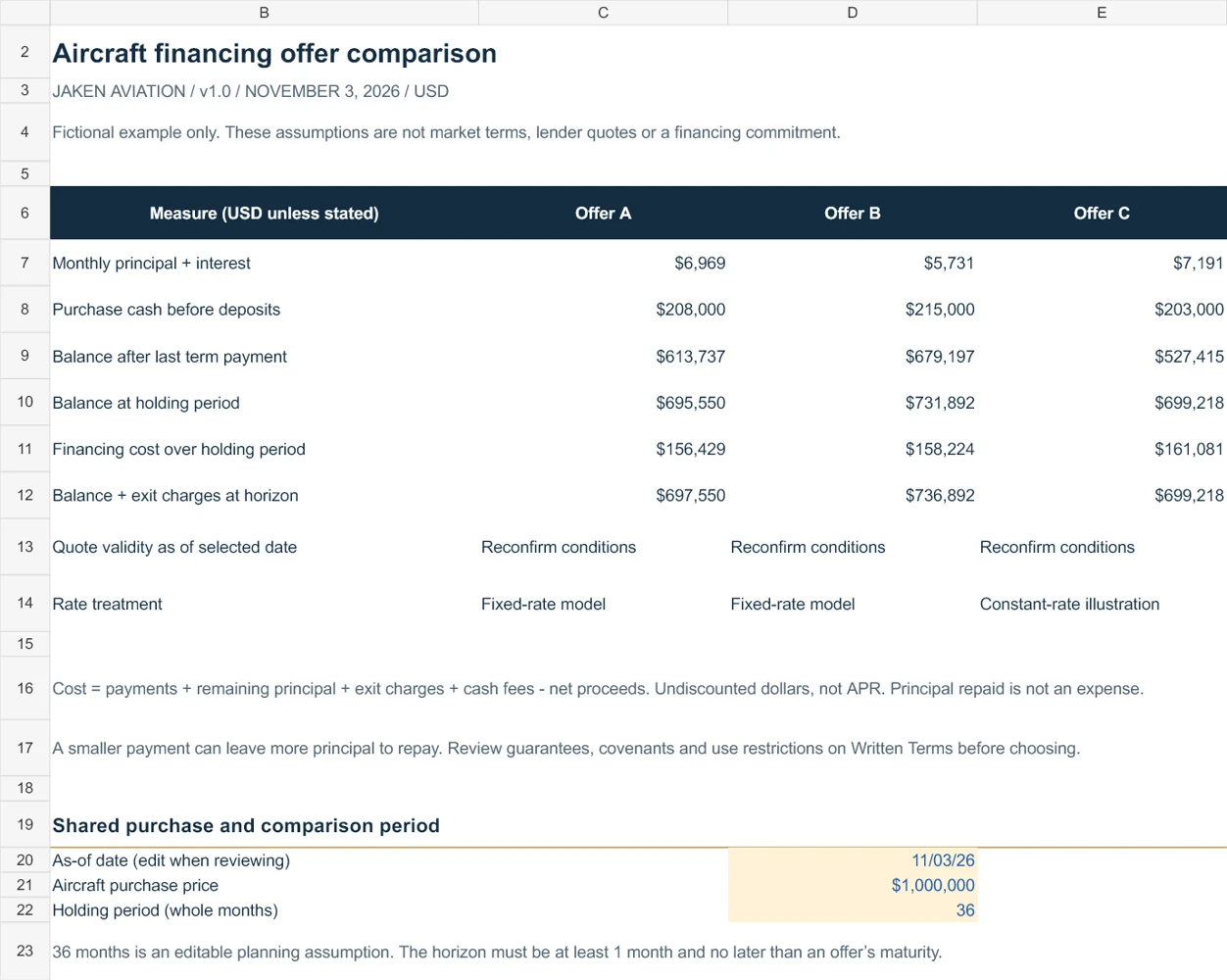
Start with the same transaction and timeline
A useful aircraft financing comparison begins with the same aircraft, intended use, borrower structure and proposed closing date. Give each lender the facts it needs to define an actual offer. Then record the quote version and expiry date, the amount advanced, the proceeds applied to the purchase, and the fees that affect your own cash. A verbal rate indication is only one input to that discussion.
The workbook accommodates up to three written offers. You enter one purchase price and a shared holding period in whole months. Each offer retains its own principal, rate, amortization and maturity. An unfilled third offer does not block the other two. A comparison period beyond an offer's legal maturity is flagged rather than silently assuming that a refinance will extend the loan.
The default 36-month holding period is an editable planning assumption. It is not a recommended ownership period or a prediction of when you will sell. Choose a period that matches the question you are asking, and review whether every offer can remain outstanding for that long.
Separate the payment from the maturity obligation
The monthly payment uses gross principal, the annual nominal rate divided by 12, and the amortization period. The model assumes equal monthly payments at period end and a constant rate. Microsoft documents these assumptions for PMT. Separate fees, taxes and reserves do not become part of the payment just because they relate to a loan.
Legal term is when the debt matures. Amortization is the repayment period used to size the installments. If amortization runs longer than the term, principal can remain after the last scheduled term payment. The workbook calculates that remaining balance separately. AOPA discusses this distinction in aircraft financing; its examples are not promises about Jaken or another lender's current terms.
Read the calculated maturity balance as a repayment obligation. The workbook does not establish that another lender will refinance it, that aircraft value will cover it, or that a buyer will purchase the aircraft on the necessary date. Review your source of maturity funds with the actual financing team.
Understand net proceeds and avoid counting fees twice
Gross principal is the opening debt balance. If it includes a financed fee, the same dollars are not all available toward the aircraft price. The kit subtracts the financed-fee input to show net proceeds applied to the purchase. It does not add that fee to principal a second time. Cash financing fees are entered separately.
Its purchase-cash figure is price minus net proceeds plus entered cash fees. This is a financing comparison before deposits and other acquisition costs. It excludes sales taxes, operating reserves, inspection costs and any other amount you have not included in the cash financing-fee input. Reconcile your complete transaction in the Pre-Buy & Closing Readiness Kit.
Enter an explicit zero only after confirming that no fee applies. A blank exit-cost field keeps the cost estimate unavailable. Ask whether the lender has already netted a charge from proceeds or included it in the quoted principal, and classify it once. Jaken fees are due at closing; nothing is charged upfront. Third-party expenses follow their own terms.
Compare financing cost over a common holding period
The cost estimate adds scheduled payments through the selected horizon, principal still owed at that point, entered exit charges and cash fees, then subtracts net proceeds received. Including remaining principal makes slower repayment visible. Subtracting proceeds removes principal received from the financing expense. Under the model's assumptions, the result captures interest plus the entered financed, cash and exit fees.
This is an undiscounted dollar comparison. It is not APR, an effective annual rate, a tax calculation, a discounted cash-flow valuation or a guarantee of a payoff amount. Differences in proceeds and repayment schedules still matter. A loan that advances more money is not economically identical to one that leaves more of your cash in the aircraft.
The horizon assumes settlement immediately after its last scheduled monthly payment. Obtain each lender's own dated payment and payoff illustration to resolve daily interest, odd first periods, rounded installments, release charges, notice requirements and prepayment provisions. FV documentation explains the constant-period balance calculation; it does not supply those contract-specific charges.
Treat variable-rate results as illustrations
You can select Variable illustration for an offer and enter an annual nominal rate. The model holds that rate constant for all periods. It does not forecast an index path or implement future resets, caps, floors, lookbacks or a lender's day-count method. The summary labels that offer as a constant-rate illustration.
Record the exact index, margin, reset interval and fallback language in Written Terms. The New York Fed's SOFR page describes an overnight secured benchmark. A contract's index variant and conventions can differ from a headline overnight number. The workbook imports no current benchmark and makes no claim that a particular index is available for your transaction.
Ask the lender for scenarios using the actual reset provisions and timing. A payment modeled at today's entered rate does not show the full range of future obligations. Compare the resulting cash demands with your own liquidity and the maturity repayment plan, rather than treating a single illustration as a forecast.
Put the nonfinancial obligations beside the numbers
The second tab provides 14 comparison topics, a separate written-answer and source field for each offer, and six follow-up rows with owners, dates and review evidence. Capture guarantee scope, other collateral, prepayment rights, covenants, reporting, aircraft use, insurance, maintenance and funding conditions. The kit does not assume every lender imposes the same requirements.
A lower coupon may accompany obligations you value differently. A higher payment may reduce the balance you must settle later. Those are tradeoffs for the borrower and its advisers to assess; the kit assigns no hidden score and selects no winner. Use document references to distinguish a confirmed clause from a question that remains open.
AOPA Aviation Finance's FAQ illustrates why prepayment, financed costs, use and insurance deserve separate questions. Its provider-specific policies should not be substituted for your own written offers. For disclosure coverage, Regulation Z includes business-purpose, organizational and other exemptions. The responsible lender and counsel should determine which requirements apply to your transaction.
Use the files without sharing your loan figures online
Only email is required to request the enhanced package. Aircraft category and purchase timeline are optional. Netlify Forms records that request and sends Jaken Aviation a notification. After the verified submission unlocks access, Excel starts downloading on the confirmation page, with a separate button for the PDF guide. Spam review can delay that verification; the page provides a retry and contact path without requiring another request.
The download session lasts 24 hours in that browser. Your workbook calculations stay in the copy you save. These files contain no macros, external data connections or upload feature. Use secure document references rather than account numbers, tax returns or identity records in a copy you intend to share.
The six-page PDF provides the method, a fictional three-offer comparison, contract questions, a printable follow-up worksheet and the source register. Loan inputs in the delivered Excel file start blank. The existing public offer-comparison guide and CSV, loan calculator, borrower questionnaire and other public resources remain available. Requesting this package is separate from a financing inquiry.
Offer comparison kit questions
What should I compare besides the aircraft loan interest rate?
Compare net proceeds, cash fees, monthly payment, amortization, maturity balance, holding-period exit costs, guarantees, covenants, use restrictions and quote conditions. Record the written source for each item rather than treating an advertised rate as a complete offer.
How does the kit compare offers with different amortizations?
It calculates the monthly payment using each offer's amortization and the remaining balance at its legal maturity. A shared whole-month holding period shows payments and remaining principal on a consistent timeline, provided the period does not exceed that offer's maturity.
Does a lower monthly payment mean an aircraft loan is cheaper?
A lower payment can result from slower principal repayment. Review the maturity balance, net proceeds, fees and financing cost over the same period. The kit does not rank offers or decide whether their nonfinancial obligations fit your situation.
Does the workbook calculate APR?
No. It calculates an undiscounted dollar financing-cost estimate over an entered holding period. This is not a regulatory APR, effective annual rate or legal disclosure. Obtain the applicable disclosures and transaction-specific advice from the responsible lender and advisers.
Can I compare a variable-rate aircraft loan?
Yes, as a constant-rate illustration using the annual rate you enter. The workbook does not forecast index changes or implement resets, floors, caps or day-count conventions. Record those contract terms separately and request the lender's own payment and payoff scenarios.
How are financed fees treated?
Gross principal includes any financed fee. The financed-fee input reduces the net proceeds applied to the purchase; it is not added to principal again. Cash fees are entered separately. Enter zero explicitly after confirming that a fee does not apply.
What happens after I submit my email?
Netlify Forms records the kit request. After the submission is verified, the confirmation page starts the Excel download and offers the PDF guide. The access session lasts 24 hours in that browser. No email inbox verification is required; spam review can delay access.
Do I have to provide financial statements to download the kit?
No. Only email is required; aircraft category and purchase timeline are optional. Your loan figures stay in your saved files. The resource request is separate from a financing inquiry. Jaken fees are due at closing; nothing is charged upfront. Third-party expenses follow their own terms.
Sources and scope
Opened November 3, 2026. Equations, comparison prompts and fictional examples are original planning tools. No lender approval, source endorsement or current rate quote is implied.
- Microsoft Support: PMT function — PMT models constant periodic payments at a constant rate. Monthly periods require a monthly rate; the result excludes separate fees and taxes. Formula documentation, not aircraft pricing or a lender repayment schedule.
- Microsoft Support: FV function — FV uses consistent payment periods and cash-flow signs to calculate a balance under constant-rate, constant-payment assumptions. Actual payoff amounts can differ because of timing, day count, rounding and charges.
- AOPA: Aircraft financing types — Aircraft loan term and amortization can differ, creating a remaining maturity balance; intended use also affects available financing structures. AOPA's examples describe its market experience. They are not Jaken commitments, universal terms or current quotes.
- AOPA Aviation Finance: Frequently asked questions — Its FAQ treats prepayment, financed costs, aircraft use, insurance and tax questions as separate financing considerations. Provider-specific policies are not generalized to Jaken or another lender. Confirm each written offer.
- Federal Reserve Bank of New York: SOFR — SOFR measures overnight Treasury-collateralized borrowing costs. It is a reference rate, not an aircraft borrower's full loan rate. No current rate is imported. The contract determines index variant, margin, floor, reset and fallback.
- CFPB: Regulation Z, section 1026.3 — Regulation Z contains business-purpose, organizational and other exemptions. Coverage requires transaction-specific analysis. The kit does not determine legal coverage or calculate a regulatory APR. Do not assume mortgage disclosures apply to every aircraft loan.